
Dorset Speed facebook group was shut down!!
Here is the link to the new group
|
Evidence of negative effects of
speed cameras
http://www.questia.com/library/1G1-108493215/speed-cameras-obsession-raises-drink-drive-toll
Speed Cameras 'Obsession' Raises Drink-Drive Toll
http://www.dailymail.co.uk/news/article-1353829/Axing-speed-cameras-caused-road-deaths-FALL.html
Axing speed cameras has caused road deaths to FALL
http://www.dailymail.co.uk/news/article-1300830/Speed-cameras-caused-28-000-accidents-decade.html
Speed cameras have caused 28,000 accidents in a decade
http://au.news.yahoo.com/thewest/a/-/national/14961137/officer-hurt-as-car-hits-speed-camera-van/
Senior Sergeant Ian Jones said the driver of the car that hit the van had braked and lost control as he came over a hill.
"The vehicle then slid sideways and collided with the rear of the police camera van," he told ABC radio.
http://www.thisisbristol.co.uk/Number-accidents-dropped-Bristol-speed-cameras/story-15828136-detail/story.html
The number of accidents has dropped since Bristol speed cameras switched off. The Avon and Somerset safety camera partnership, which ran the cameras, was disbanded last year and the fixed cameras were turned off in March.
http://www.bbc.co.uk/news/uk-england-northamptonshire-17599294?
The number of road deaths in Northamptonshire fell to an all-time low in 2011, police figures show. The figures, the lowest since records began in 1960, coincided with the year the county's
road safety partnership was disbanded and fixed speed cameras were switched off.
http://www.timesonline.co.uk/tol/news/uk/article536440.ece
Police remove ten speed cameras over safety fears.
“We recognise that there is a potential safety hazard from sudden braking if you
can’t see the camera”
http://www.dailymail.co.uk/news/article-1227998/Speed-camera-rakes-500-000-year-blamed-doubling-motorway-casualties.html
Speed camera that rakes in £500,000-a-year blamed for doubling of motorway
casualties
Dorset Road Safe was made aware of some negative effects in August last
year:http://www.thisisdorset.net/news/tidnews/8316512.print/ It said at the time it had “no
knowledge of this report” but it most certainly did after this time. “Thirty one per cent of motorists
questioned in a poll of 1,532 drivers have witnessed an accident or a near-miss
as a result of drivers’ erratic behaviour when faced with a camera with five per
cent braking suddenly when a camera come into sight.”
Motorcyclist killed in A316 speed camera crash
http://www.ealingtimes.co.uk/news/207418.motorcyclist_killed_in_a316_speed_camera_crash/
Letter from Transport-watch
http://www.thestar.co.uk/news/local/safety_cameras_flawed_1_4007369
One site which has seen accidents increase is the county’s ninth top earning
site - the A625 Ecclesall Road South near Ringinglow Road which snapped 2,421
drivers and made £39,480 through fines.
Obstruction due to badly positioned "safety" vans
http://www.pistonheads.com/news/default.asp?storyId=24013
"Three speed cameras in Preston that pulled in £18,000-worth of fines in 2010
actually bore witness to an increase in the number of accidents since they were
installed."
"Not only is it scandalous that cameras where casualties have increased have
been kept in operation for many years, it is even more disturbing that the
authorities have hidden this data and authorised continued operation whilst
being in possession of this knowledge"
http://www.dailyrecord.co.uk/news/2009/02/08/speed-camera-panic-may-have-caused-death-of-motorist-78057-21106048/
A DRIVER may have been killed because he braked suddenly after spotting a speed
camera. Police say Graham Davies, 45, is unlikely to have even been speeding
when he lost control of his car.
http://news.bbc.co.uk/1/hi/england/manchester/3721018.stm
A driver who knocked down a 69-year-old woman
could have been distracted by a speed camera, a coroner said.
http://www.bournemouthecho.co.uk/news/districts/bournemouth/9212663.Motorcyclist___s_death_on_Spur_Road_linked_to_speed_camera/
AN experienced motorcyclist lost his life after braking too hard – almost
certainly because he had just spotted a speed camera van at the side of the
A338 Spur
Road, a Bournemouth inquest has heard.
http://www.dailymail.co.uk/news/article-2047509/Motorcyclist-sets-speed-camera-sliding-ground-WITHOUT-bike.html
"A police spokesman said: ‘It appears that he suddenly saw the traffic control
measure ahead and lost control as he tried to slow down."
http://www.bournemouthecho.co.uk/news/8838905.Bournemouth_inquest_hears_biker_was_killed_trying_to_overtake_van/
Coroner Sheriff Payne said the evidence suggested that Mr Richardson ‘slowed
down for the speed camera, dropped a gear then accelerated quite hard from the
speed camera’. (Distraction)
Prof Richard Allsop and, by association, the RAC Foundation, admits that ... In common
with many other safety interventions, speed cameras can have unintended
consequences and have given rise to some collisions and casualties that would
not have occurred if the cameras had not been deployed.
Videos
of crashes that have occurred in front of speed cameras for no other reason than
braking for the camera. http://www.youtube.com/watch?v=xJLlH6GgmfU
40 negative effects were listed here in 2007:http://www.safespeed.org.uk/sideeffects.pdf
"Speed cameras 'do not cut accidents'... they create them, study finds"
"The MP said he was aware of one camera at Queensway in Hemel Hempstead that had
caused rather than prevented accidents."
New statistics from the Department for Transport have
today revealed what has been believed about speed cameras for quite some time.
Namely, they regularly fail to cut accident rates and can
even increase them.
"Accidents rise despite presence of speed cameras"
"Casualty rates at some speed camera sites have worsened since their
installation, figures out today showed."
http://www.transport-watch.co.uk/transport-speed-cameras.htm
Prior to 1995 deaths per
vehicle-mile were falling at 7% per year. After that date, instead of
accelerating under the impact of the cameras, that beneficial trend collapsed to
2.5%. Had the previous trend continued there would have been 10,000 fewer
deaths that actually occurred. There is also a remarkable correlation
between those extra deaths and the number of fines
(2002)
http://news.bbc.co.uk/1/hi/england/2212479.stm
"Speed cameras can cause accidents
rather than prevent them, according to research carried out in Leeds.
Researchers found seeing a speed
camera can distract drivers and cause them to slam on the brakes.
Accident rates were studied on two
of the main roads in and out of Leeds.
In both cases, accidents have
increased since cameras were installed."
http://www.speedcamerareport.co.uk/10_effects_of_cameras.htm
POSITIVE BENEFITS AND NEGATIVE SIDE EFFECTS OF SPEED
CAMERAS ON ROAD SAFETY.
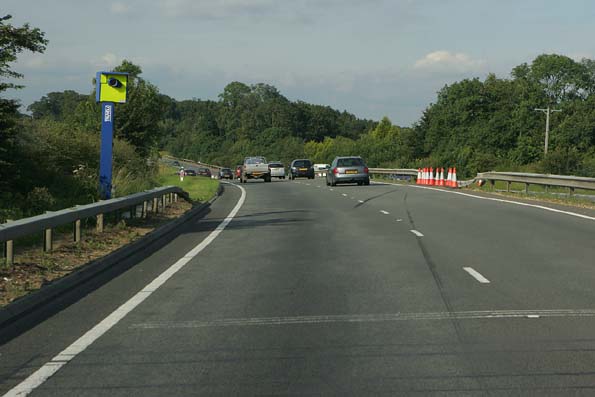
About average speed cameras:
Prof Allsop's quote can be found in the Q&A download
at
This is a bit lengthy, but shows that average speed
cameras are little better than fixed or mobile when considering negative
effects.
Average speed cameras (ASC) have
been hailed as revolutionary – avoiding the problems of distraction and sudden
braking associated with fixed/mobile cameras.
But the Highways Agency's report “Safety
Camera Technology at Roadworks – Final Report, March 2008”, concedes
that several hazards are created by the deployment of ASCs:
·
Sudden
braking
·
Distraction
·
Reduced
headway (time between vehicles) - exacerbated by the sudden braking
·
Lane
changing
The report also acknowledges
that there are no proven safety benefits (collision/casualty reduction)
and that driver education campaigns may become of increased importance to
encourage “correct behaviour” in the presence of the cameras.
These conclusions are all the
more surprising when you realise that the participants in this study were
employees of the HA or the consultancy preparing the report (many subjective
comments suggest that they are predisposed to the “potential benefits of speed
cameras”).
The HA report can be
downloaded from
http://www.ha-research.gov.uk/projects/index.php?id=1258
Safety engineering is guided
by a number of principles, one of the most important being the order of
precedence for methods to address hazards, as follows:
-
Eliminate the hazard.
-
Reduce the risk associated
with the hazard or accident by implementing engineered mitigation strategies
(eg. safety interlocks, such as the safety catch on a gun).
-
Reduce the risk associated
with the hazard or accident by implementing mitigation strategies based on human
factors (labelling, training or procedures).
In the case of ASCs, the
source of the hazard is clear – it's the introduction of the cameras. It is no more than wishful thinking
that drivers can be educated to deal with that hazard - that is very poor,
indeed culpable, safety engineering.
As there is no safety argument
for using the cameras, the first choice is to remove the cause of the hazard
(i.e. take away the camera);
increased signage and driver education (as proposed by the report) to mitigate
the hazard are covered by number 3 on the list and are therefore much less
satisfactory and will never be as beneficial as eliminating the source of the
hazard.
A “safety device” that
actually reduces road safety until drivers adjust to it is totally alien to all
safety thinking and culture.
The HA report was comparing
ASCs with fixed cameras, concluding that ASCs had fewer drawbacks. I have
explained above that there is no safety argument for the deployment of ASCs, and
it therefore follows that no speed
camera should be allowed to be deployed on our roads as it is clearly decreasing
road safety. Mobile cameras are worse than fixed cameras in this respect.
DANGER to speed camera operators:
http://www.visordown.com/motorcycle-news--general-news/us-biker-shoots-dead-speed-camera-operator/6813.html
http://www.thenewspaper.com/news/36/3637.asp
http://www.pocketgpsworld.com/modules.php?name=News&file=article&sid=1538
..And no positive effects?
"SPEED cameras have failed to cut accidents at almost half of all sites where
they have been installed in South Yorkshire"
"SPEED cameras installed to stop accidents are not doing their job, according to
national figures"
"SPEED cameras in South
Bucks are failing to cause accident rates to drop
despite successfully bringing average speeds down."
"In Midsomer Norton and Radstock, none of the areas where mobile camera vans
operate has seen a significant fall in accidents since their introduction."
"Speed cameras have little or no effect on reducing road accident on roads in
the West Midlands, statistics released today suggest."
|